By Uranium Technologies Limited SAP Consultant Team.
For twenty years, I have seen manufacturing giants like Uranium Technologies Limited build architectural masterpieces of efficiency. You have optimized your shop floors, negotiated ruthless procurement deals, and refined your logistics. But there is a silent killer lurking in your stack. It’s not your machinery; it’s your data.
You are drowning in information but starving for knowledge. When a critical supplier in East Asia goes offline due to a geopolitical event, or a vital component for Uranium Technologies' specialized machinery fails a quality check, your response isn't a strategy; it's a scramble.
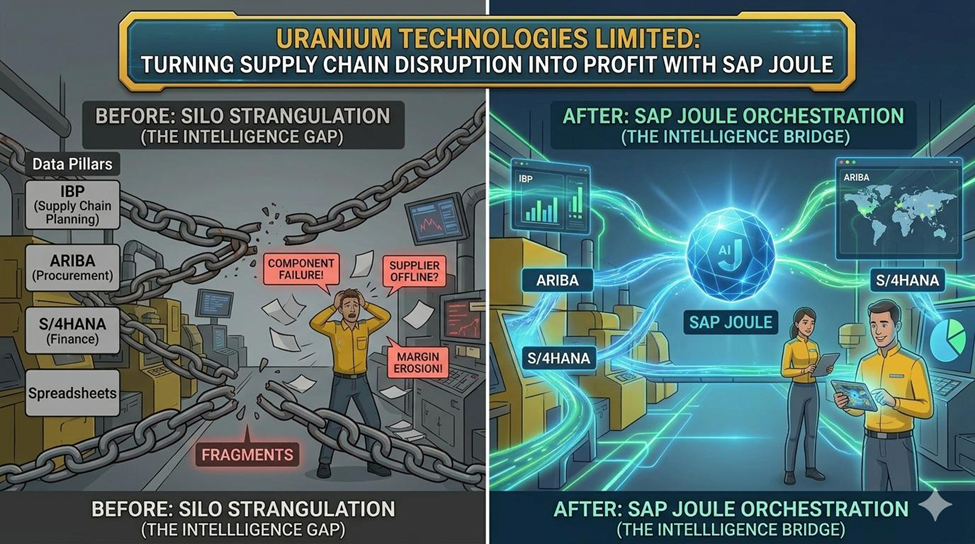
This is the Silo Strangulation. Your data is trapped—in S/4HANA Finance, in Ariba Procurement, in SAP IBP (Integrated Business Planning), and in countless localized spreadsheets. You are trying to fight a modern, high-speed battlefield with paper maps.
The Major Industry Issue: The Intelligence Gap in Crisis Management
The core problem facing heavy industry today is the lack of Cross-Functional, Context-Aware Intelligence. In a traditional setup, when a disruption occurs:
- Supply Chain Planning detects a stockout risk (in IBP).
- Procurement must be contacted manually to find alternative suppliers (in Ariba).
- Finance must assess the impact on margin (in S/4HANA).
- Logistics must reroute shipments (in TM).
This process takes days, sometimes weeks. By the time a decision is made, the market has moved, competitors have seized the initiative, and Uranium Technologies’ margins have eroded. You need an automated general that understands the entire battlefield.
Enter SAP Joule: From Passive Copilot to Proactive Orchestrator
This is where the paradigm shifts. We are no longer talking about generative AI that merely summarizes meetings or drafts emails. SAP Joule has evolved. It is no longer just a passive copilot; it has become an Agentic Orchestrator.
Joule is now embedded directly into the foundational processes of the SAP ecosystem—RISE with SAP, S/4HANA Cloud, IBP, and BTP. It doesn’t just answer questions; it executes multi-step workflows across systems.
How SAP Joule Solves the Silo Strangulation (Specifically for Uranium Technologies):
Let’s imagine that component failure scenario again.
Phase 1: Proactive Detection & Deep Research
Instead of waiting for a manual report, Joule, working within SAP Integrated Business Planning, detects an anomaly in quality control data that will cause a 20% production delay on Uranium’s core product line.
Joule doesn’t just sound an alarm. Using its new Deep Research capabilities, it cross-references this failure with internal production schedules in S/4HANA and external market intelligence. It determines that the failure is systemic to a specific batch from Supplier A.
Phase 2: Cross-Enterprise Orchestration
Joule immediately moves from analysis to action. It opens SAP Ariba and simultaneously:
- Identifies three pre-approved alternative suppliers (Suppliers B, C, and D) who can supply the identical component.
- Initiates a conversational interaction with Uranium’s Procurement Lead via the Joule Action Bar (which follows them across applications). It presents the problem and the pre-researched solution.
"Joule: Critical quality failure detected for Component X. Impact: 20% production delay. I have identified 3 alternative suppliers in Ariba. Shall I draft RFPs or request spot quotes?"
Phase 3: Autonomous Workflow Execution
Upon user approval, Joule:
- Generates and sends RFPs to Suppliers B and C via Ariba.
- Accesses S/4HANA Finance to recalculate the forecasted margin based on the slightly higher cost of the spot quotes from the new suppliers, presenting a clear financial comparison to Uranium's CFO.
- Automatically updates the Master Production Schedule in S/4HANA to prioritize high-margin orders that are unaffected by the component shortage.
See the Transformation: Fragmented Chaos vs. Joule Orchestration